Case study
A wide range that does not turn into a maze.
Four enclosure types, mirrors, partitions and railings, and coverage of more than thirty towns. All of it had to fit a structure in which the buyer does not get lost.
Level 3Authority / Local SEO
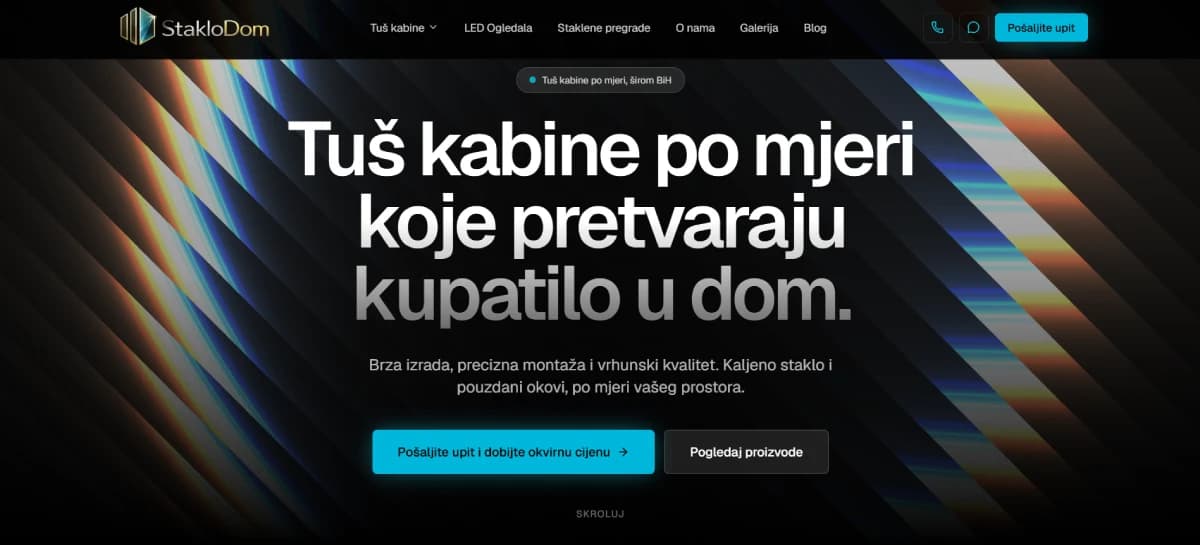
The job
When the range grows, the site becomes a maze.
The company covers more than thirty towns and sells several product groups. On a site like that the easiest thing is one „Products“ page holding everything, and with it you lose every buyer looking for exactly one thing.
The job was the opposite: let the buyer reach their product and their town in two clicks, and send an enquiry from there without going back.
Architecture
Two axes, product and town.
A buyer arrives either through the product or through the place. The structure has to support both paths rather than pick one.
A category per enclosure type
Folding, sliding, walk-in and outward opening, each its own page. Those are four different buyers, not four photographs of the same product.
A page per town
Town pages are done responsibly or not at all: each carries its own content rather than the same text with the name swapped. The client confirmed they are genuinely different.
A blog that answers before the sale
Which glass to choose and how to measure a bathroom. Those are the questions a buyer asks before they know who to contact.
Decisions
Three decisions that carry the conversion.
- The form asks for town and dimensionsAn enquiry that arrives with a town and measurements can be answered with a quote rather than a question. The first round of back and forth disappears at the start.
- Free measuring as the main offerNot a discount and not a sale, but the removal of risk. A buyer who does not know their measurements has an excuse not to get in touch; this way they do not.
- Phone and WhatsApp fixed on mobileMost visits come from a phone. A contact you have to scroll for is a contact some people will never find.
Result
What was actually measured.
The figures come from that site's Google Search Console. None is an estimate and none is rounded up.
601
Clicks from search
6,587
Impressions in search
6.84
Average position
Period: May 26, 2026 to August 25, 2026. Search Console export: August 27, 2026.
First 28 days against the last 28
The same period split at both ends, because that is the only comparison this data allows. Position is better when it is lower, so a positive number means a step forward.
- Clicks from search
- +1,052%
- Impressions in search
- +1,317%
- Average position
- +0.41
123Clicks from search
That is what five town pages brought, alongside 957 impressions, and all of it in the last 28 days of the period. Before that those same pages had zero clicks and zero impressions, because they did not yet exist.
This is the curve of a site entering the index, not the repair of an existing one: at the start of the measured period the site had almost no impressions at all. That is why the percentage looks dramatic and why it should be read as entry into search, not as a turnaround. Average position improved along the way, which is the harder part.
Search Console measures search, not business. These numbers say how many people see the site and how many click, but not how many enquiries turned into work. That figure sits with the client and is not here, because any estimate of mine would be an invented number.
What next
The remaining towns, and measuring the form.
Five town pages work. The next step is the rest of the coverage, under the same rule that every page must have its own reason to exist, and measurement of how many enquiries actually come from which page.
Next step
Your site, the same approach.
Send the address of your current site, or say there isn't one. I return a recorded walkthrough and a list of what you would actually need, with no obligation.